Think & Discuss
Quick Check
Inquiry Task
Empire provided railways with funding, engineering knowledge, survey data, and colonial outposts, while railways strengthened the empire’s capacity for military deployment, resource transport, and market integration, demonstrating the material superiority of the science–industry–empire complex. The uneven diffusion shows that this capacity depended heavily on imperial networks and capital rather than natural spread. The dismantling of China’s first railway and the extremely short Persian railway also show that local regimes and societies could resist or limit this empire-led infrastructure, indicating that the relationship was not frictionless.
Learning objectives for this page: to explain how modern science and European empires supported each other in expeditions, surveying, natural history, archaeology, and linguistics; to analyze how the exploratory mindset of “acknowledging ignorance” was expressed in blank spaces on maps, the conquest of the Americas, and global imperial expansion; and to compare European expansion with Zheng He’s voyages and the different attitudes toward overseas expansion held by non-European powers such as the Ottomans and China.
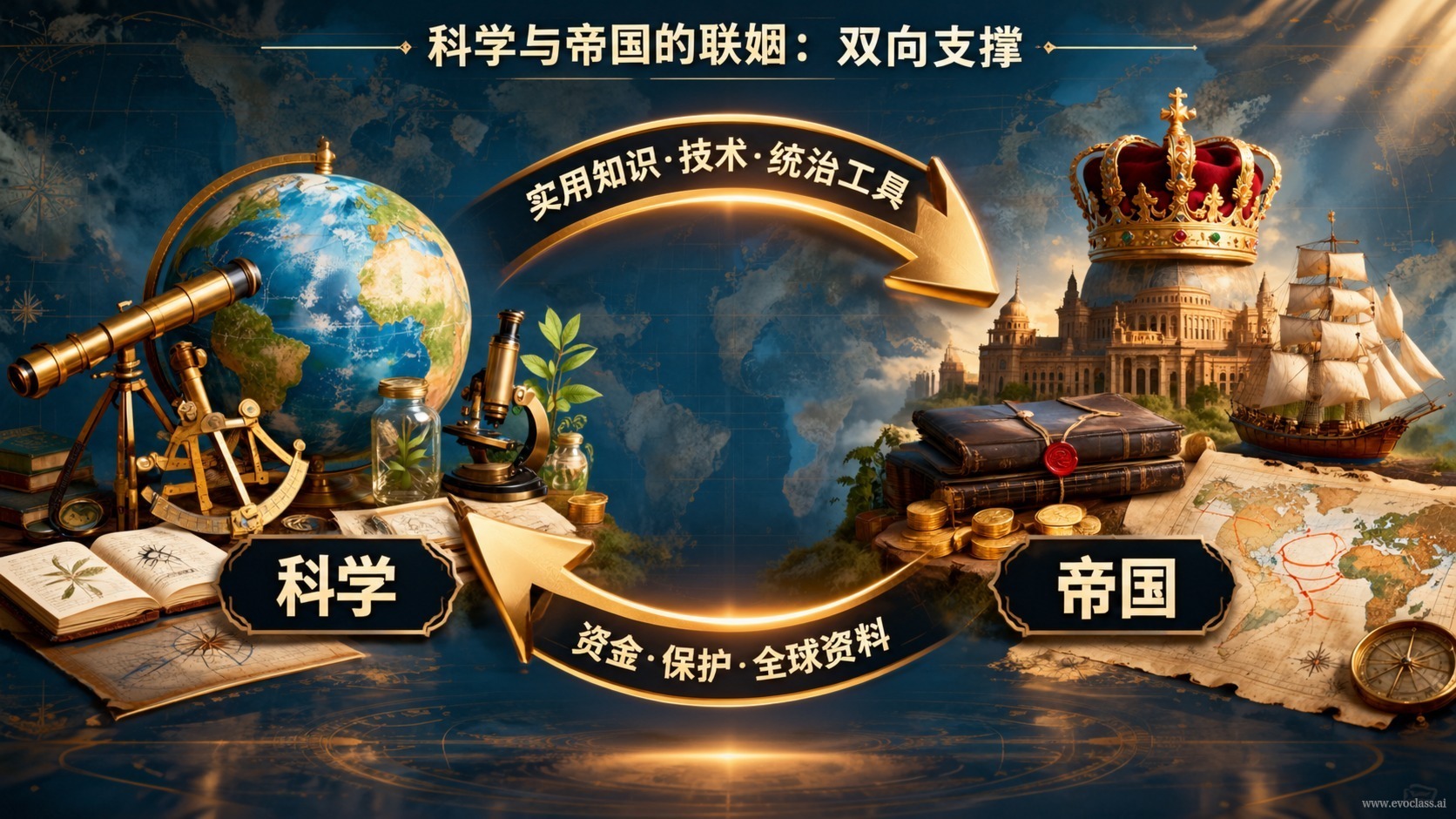
In the 18th and 19th centuries, modern science and European empires formed aco-constituted marriage: the empire used funding, protection, transport, and colonial networks to expand the reach of scientific collection; science used practical knowledge, technology, measurement and classification, and governance tools to enhance imperial power. The two were not a one-way instrumental relationship, but mutually reinforcing and jointly expanding.
From empire to science: the empire provided funding, ships, protection, colonial outposts, global specimens and data, research stations, and administrative support; scientists often relied on navies, colonial officials, missionaries, and trading companies to enter the “field.”
From science to empire: science provided practical knowledge (navigation, medicine, engineering, statistics), technologies (railways, steamships, telegraphs, weapons), and tools of rule (map surveying, censuses, natural history classification, linguistic and legal codification).
Two-way mechanism: knowledge strengthens imperial capacity → the empire expands global data collection → data flows back to Europe and advances scientific theory and authority → science once again provides the empire with new capabilities, forming a feedback loop.
This mindset of “exploration and conquest” is clearly visible in the evolution of world maps. Before the modern era, many cultures already had their own world maps, but when they encountered unfamiliar regions, they either omitted them entirely or filled them in with imagined monsters and marvels; these maps had no blank spaces, creating the impression that the whole world was already within their grasp.
In the 15th and 16th centuries, large blank spaces began to appear on Europeans’ world maps. These blanks can be seen as a major psychological and intellectual breakthrough, clearly showing that Europeans were willing to admit they still knew nothing about a large part of the world. Thisacknowledgment of ignoranceexploratory mindset both drove scientific expeditions and served imperial expansion.
In 1492, Columbus set sail westward from Spain, hoping to find a new route to East Asia. He still believed in the old world maps and thought the whole world was fully laid out on them. According to those old maps, Japan should have been about 7,000 km west of Spain, but in fact the distance from Spain to East Asia is more than 20,000 km, with the American continent in between. At around 2 a.m. on October 12, 1492, the lookout on the Pinta, Juan Rodríguez Bermejo, spotted from the mast what is now the Bahamas and shouted, “Land! Land!” This contact was a classic example of outward exploration after “acknowledging ignorance.”
Therefore, blank spaces on maps were not merely a cartographic change; they also corresponded to the cognitive shift behind the conquest of the Americas and global imperial expansion: first acknowledge the unknown, then bring it into the realm of the known and controllable through expeditions, surveying, and colonization.
The domains of mutual support included expeditions and navigation, map surveying, natural history collecting, archaeological excavation, and linguistic decipherment. They served both imperial governance and the accumulation of knowledge within the scientific community.
Railway mileage can serve as a concrete indicator: in 1830 Britain opened the world’s first commercial railway; in 1850 Western countries had nearly 40,000 km while Asia, Africa, and Latin America had only about 4,000 km; in 1880 the West had over 350,000 km while other regions had about 35,000 km; China’s first railway in 1876 was built by Europeans and dismantled the following year; Persia’s first railway in 1888 was only about 10 km long. This data reveals the material superiority and uneven diffusion of the science–industry–empire complex, and shows that railways were not just technology but infrastructure for military deployment and market integration.
This marriage gave rise to modern disciplines such as geography, natural history, archaeology, and linguistics, but also justified colonial rule, catastrophes for indigenous peoples, racism, and culturalism. Yet science was not a pure tool of empire, nor was empire science’s only patron; the relationship was an entanglement of interests, institutions, personnel, and data.
Comparative perspective: European expansion was supported by scientific institutions, chartered companies, and colonial administration, forming lasting overseas empires; Zheng He’s voyages (1405–1433) were mainly state-led tributary voyages and did not establish sustained overseas colonies or a science–empire complex; powers such as the Ottomans and China focused more on land-based expansion and continental governance and were cautious about overseas expansion. This suggests that the close marriage of science and empire was a product of specific historical conditions, not the only possible path.
A diagram with a double-headed arrow, with “Science” on the left and “Empire” on the rightObserve the double-headed arrow diagram, with “Science” on the left and “Empire” on the right, and the arrows labeled “practical knowledge / technology / tools of rule” and “funding / protection / global data.” Think about how it relates to “science provides the empire with practical knowledge, technology, and tools of rule.”